

The Truth About Carbs
While dietary ideologues play games with nutrition, the best athletes tune out the noise and do what works


Tim Noakes hates carbs. A lot. His Twitter/X account has almost a quarter of a million posts defaming the most abundant macronutrient in nature. He has blamed carbs for everything from Alzheimer’s disease to the Holocaust (no joke) and labeled the USDA’s former grain-heavy dietary recommendations “genocide”. One wonders if carbs did something to hurt little Timmy when he was a boy—bullied him at school or whatever.
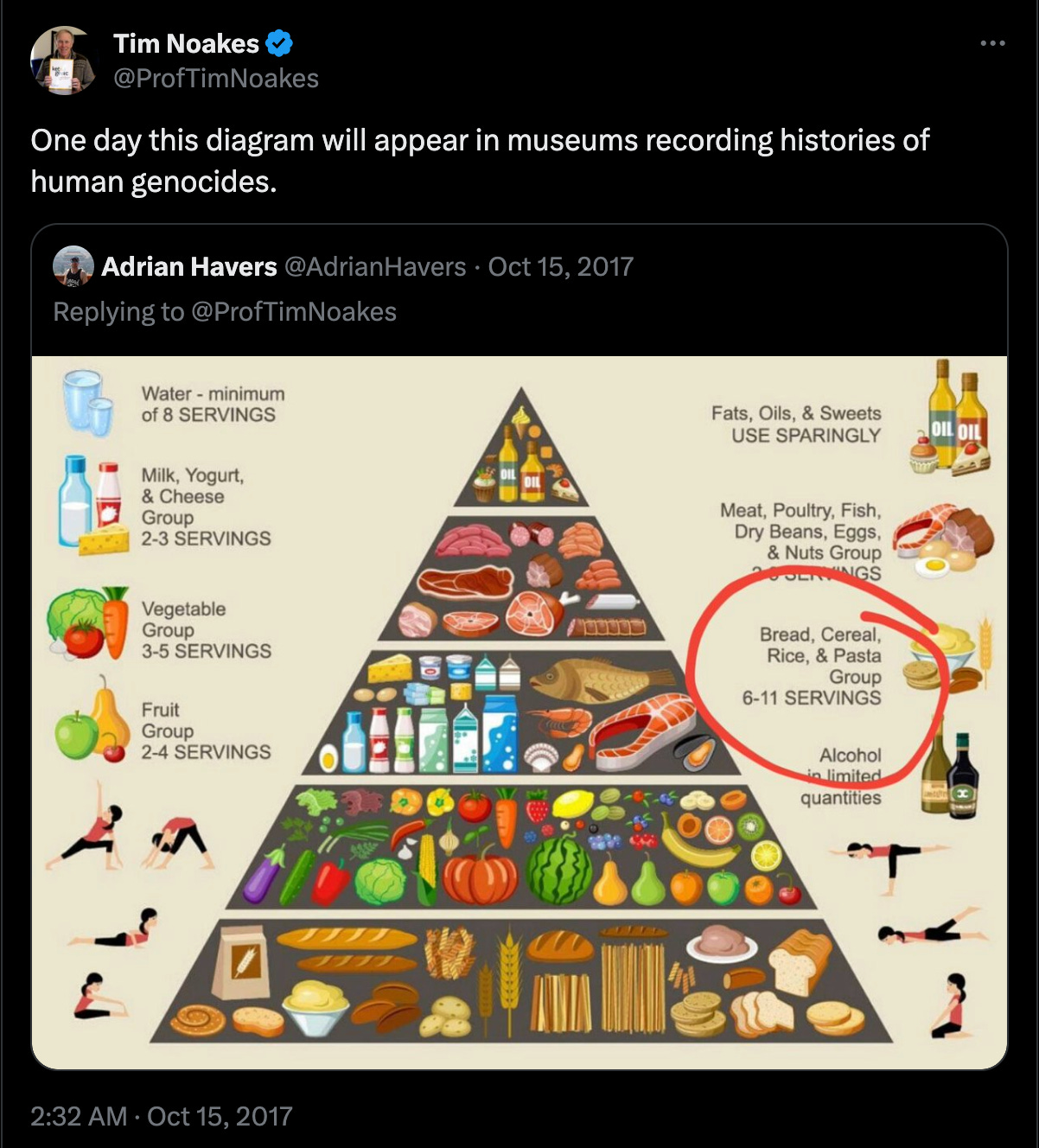
Dedicating your life to demonizing a certain type of molecule in food seems weird to me, and also sad, but funny too. I’m with Jesus, who admonished the diet-policing Pharisees, “It is not what enters into the mouth that defiles the man, but what proceeds out of the mouth, this defiles the man.” Amen, brother.
But hey, it’s a free world, and if a guy can make a name for himself by disparaging pasta, more power to him. The problem, however, is that, in addition to being famous for saying meaner things about fruit (“a killer in sugar”) than anyone else can come up with, Tim Noakes is a scientist. Or was a scientist. It’s a bit unclear.
“He’s abandoned science,” said one of Noakes’s former PhD students in a 2016 article on outside.com. “I feel like he’s drifted away from his rigorous way of thinking and started adopting these increasingly indefensible methods. Hypocrisy, double standards, and cherry-picking — it’s all a bit disappointing.”
I know the feeling. I used to email Noakes regularly with exercise physiology questions, and he always took the time to supply a thoughtful answer. He even wrote the foreword to my 2007 book Brain Training for Runners, lending a bit of his then-considerable credibility to the project and helping it get off to a strong start saleswise. But a few years later, and almost overnight, Noakes’s public persona morphed into a ranting mouthpiece for low-carb, high-fat (LCHF) diet dogma. Mind you, I have nothing against the LCHF diet or any other way of eating. It’s the dogma part I don’t like. For me and other longtime admirers of Noakes, his hard pivot into keto sloganeering seemed a bewildering self-demotion, perhaps the most surprising voluntary exchange of greatness for mediocrity since Michael Jordan became a baseball player. Before our very eyes, this giant of exercise physiology, who’d made an indelible mark on his field with an incisive skepticism that enabled him to poke holes in sports science shibboleths and suggest better alternatives, now sounded like every other tinfoil hat-wearing low-carb zealot.
The whole purpose of science as an institution is to counter our natural tendency to believe what we want to believe instead of what reality is telling us. When I look at Noakes today I see someone who wants nothing more in the whole wide world than to keep believing what he’s come to believe about nutrition. Which is fine on social media, I suppose, but not so much in the pages of a peer-reviewed journal.
I stopped paying attention to Noakes around the time he blocked me on Twitter for calling out his latest hot take on Hitler’s vegetarianism, and I just sort of assumed he’d stopped publishing in peer-reviewed journals, or that peer-reviewed journals had stopped publishing him. So imagine my surprise when, a few weeks ago, an old friend texted me with a link to a couple of YouTube bozos hyping up a “shocking” new “myth-busting” “science” paper coauthored by none other than Tim Noakes. Following breadcrumbs, I came to the paper itself, whose title - ”Carbohydrate Ingestion on Exercise Metabolism and Endurance Performance” - made me spill my Pepsi laughing. I could already see The Onion Headline: “Man Who Called Carbohydrates ‘Worse Than Tobacco’ Authors Totally Unbiased Science Paper on Carbohydrates. Concludes They’re Worse Than Tobacco.”
The Mechanistic Fallacy
It’s impossible for an intelligent person who doesn’t hate carbs to sift through the several thousand published studies dating back to 1953 on the effects of carbohydrate ingestion before and during exercise and conclude that the practice doesn’t enhance endurance performance in a linear dose-response pattern where a little is good, more is better, and so on, up to a point. I’ve been waist-deep in this research as a layperson for thirty years and I can’t think of a single sports-nutrition fact that’s been more redundantly overproven.
When you’re up against this reality, yet you’re determined to convince people of a nonreality where carbs are bad even when taken before and during exercise, what do you do? If you’re Tim Noakes you resort to a trick I call the mechanistic fallacy, which entails spinning a physiological just-so story that predicts a certain outcome instead of simply cutting to the chase and testing the prediction. The mechanistic fallacy is a favorite trick of diet gurus who count on the low scientific literacy level of the average dieter to pass off strings of polysyllabic Latin as real science. An example of this phenomenon that’s featured in my book Diet Cults is the impressively complex biochemical just-so story that physician Peter D’Adamo spun around lectins, a type of carbohydrate-binding protein in the body, in his book Eat Right 4 Your Blood Type. Smoke and mirrors, all of it, but D’Adamo made millions.
What’s great about the mechanistic fallacy for pseudoscientists who are hell bent on duping a gullible public into believing something that is manifestly untrue is that it’s pretty easy to pull off. For example, suppose you hated caffeine and you wanted to prove that caffeine has no effect on endurance performance even though dozens of studies have shown that caffeine ingestion before and during exercise has a positive effect on endurance performance. No problem.
In 2006, scientists showed that caffeine intake before exercise sharply reduces oxygen supply to the heart. Holy Moses! Oxygen supply to the heart is vital mechanism during aerobic activity. The fact that caffeine reduces it means it can’t possibly enhance endurance performance. Never mind all those studies that say it does. Just cherry-pick a couple of studies that showed no benefit. And when you’ve got dozens of studies to choose from, there’s always at least one outlier you can exploit. I did it just now on your behalf and found a 2024 study showing that caffeine boosted performance in a Wingate test only when coingested with whey protein. That basically proves it’s useless, right?
Anyway, in his latest paper, Noakes deploys the same fallacy to argue that the true cause of exhaustion during endurance exercise is not depletion of muscle glycogen (large stores of carbohydrate in muscle tissue) but a decline in blood glucose (small stores of carbohydrate in the bloodstream), and that athletes adapted to an LCHF diet can maintain levels of blood glucose sufficient to forestall hypoglycemia with minimal carbohydrate intake before and during exercise.
The sleight of hand in mechanistic fallacies is always oversimplification. Caffeine enhances endurance performance despite its negative effect on oxygen supply to the heart because its positive effects on the nervous system counterbalance it—with interest. But if you zoom in on the heart, you can make a sucker forget about the brain for a minute. Likewise, Noakes’s bioplausible reinterpretation of known facts about metabolic limiters on endurance performance zooms in on blood glucose in the hope that we’ll forget about all that other stuff. But I’m just a dumb running coach, so what do I know? So I asked a real scientist, Patrick Wilson of Old Dominion University, for his take on the narrative Noakes unspools in his new paper, and here’s what he wrote:
Development of fatigue is likely due to a complex interplay of several inputs, both central and peripheral in nature, including frank hypoglycemia or even falling blood glucose levels in the absence of severe hypoglycemia. However, solely focusing on hypoglycemia ignores other lines of evidence that show glycogen in the muscle is still important . . . which include papers that Noakes was an author on!
Wilson shared links to three such studies, two of which Noakes was directly involved in, though perhaps those brain cells died of malnourishment:
➡️ A signaling role for muscle glycogen in the regulation of pace during prolonged exercise
➡️ The Effects of Carbohydrate Loading on Muscle Glycogen Content and Cycling Performance
Noakes does eventually get around to providing evidentiary support for the outcome predicted by his mechanistic just-so story, citing a 2025 study published in the American Journal of Physiology-Cell Physiology that he coauthored. In random order, ten competitive triathletes spent six weeks on a low-carb diet and another six weeks on a high-carb diet. At the end of each dietary intervention, they rode indoor bikes to exhaustion at a fixed intensity corresponding to 70 percent of VO2max. They did this not once but twice, in fact, receiving carbohydrate at a very low rate of 10 grams per hour in one ride and a noncaloric placebo drink in the other. Each test was preceded by a fifteen-hour fast.
The purpose of this design, ostensibly, was to determine whether carbohydrate ingestion in amounts barely sufficient to maintain stable blood glucose levels maximizes endurance performance in fat-adapted athletes. In fact, though, the protocol was cleverly framed to negate the advantages of being carbohydrate adapted (which is also a thing), akin to a wrestling champion challenging a kickboxing champion to a wrestling match to determine who’s the better fighter. Restricting carbohydrate both before and during an exhaustive exercise test that is performed at a moderate (not a high) intensity gives every advantage to the athlete who’s fat adapted. Even so, performance in the time-to-exhaustion (or TTE) test was equal on both diets, and if you toss out the guy who rode twice as long on the LCHF diet, the group as a whole performed slightly better when they were carb-adapted. Oops.
I’ll admit it is somewhat interesting that carb intake at rate of 10 grams per hour did maintain blood glucose levels, but these findings fall far short of confirming Noakes’s hypothesis, and not only because the effect was equal in carb-adapted and fat-adapted athletes. But the question Noakes really doesn’t want you to ask when you read this study is the one that any scientifically literate reader who hasn’t already made up their mind about carbs will inevitably ask: “What would have happened if the subjects had done a third TTE test in which they consumed carbs at recommended levels?” Noakes makes much of the fact that time to exhaustion was increased by 22 percent compared to placebo by the trickle of carbs subjects received in the carb-fueled time trials, hoping we’re clueless enough to conflate increased performance with maximized performance, but although the YouTube certainly were this clueless, you and I are not, and a quick glance at the most relevant existing research tells us exactly what would have happened if the subjects had been given the opportunity to complete a TTE while consuming carbs at the recommended rate of 90 grams per hour, which, of course, is that they would have lasted considerably longer than they did on 10 grams per hour, truly maximizing their performance instead of merely increasing it. We also know that the carb-adapted athletes would have lasted much longer than the fat-adapted athletes at this intake level because fat-adapted athletes lose the ability to absorb and metabolize carbs at maximal rates during exercise. Noakes himself knew this too, which is precisely why he chose not to include a third test and instead challenged a kickboxer to a wrestling match . . . which still ended in a draw!
In summary, even when carb-adapted athletes are deprived of carbohydrate before a moderate-intensity endurance test in which carbohydrate intake is severely restricted, they perform as well as or slightly better than fat-adapted athletes. To bring this conclusion closer to home, suppose the international governing body of the sport of cycling passed a weird rule requiring athletes to fast for 15 hours before competition and limiting carbohydrate ingestion during competition to 10 grams per hour. In this scenario, according to Noakes’s own research, athletes would still probably be better off avoiding an LCHF diet. And if no such restrictions were imposed, and a competitive ride to exhaustion at 70 percent of VO2max became an Olympic event, all of the medalists—and for that matter all of the qualifiers—would be athletes who ate a lot of carbs in their daily diet and consumed large amounts of carbohydrate during competition. We know this because events closely resembling a TTE test to exhaustion at 70 percent of VO2max already exist in the real world—they’re called ultramarathons, Ironman 70.3’s, and one-day classics—and the athletes who win these events are universally carbohydrate chowhounds. More about the real world in a second.
No Medals for Fat Burning
The definitive study on the true effects of LCHF in high-level endurance athletes was conducted in 2020 by Louise Burke of the Australian Institute of Sport, who at that time—and to her credit—was publicly undecided on the merits of ketogenic diets for endurance athletes. Hence, unlike Noakes’s thumb-on-the-scale 2025 study, this one featured a far less artificial design that allowed both high-carb and low-carb diets to put their best put forward, yielding far greater real-world relevance.
In Burke’s experiment, twenty-six elite race walkers were separated into two groups, one of which was placed on a high-carb diet (8.6 grams per kilogram of body weight daily) while the other adhered to a ketogenic diet (less than 50 total grams of carbs daily) throughout a twenty-five-day period of intensified training. Physiological testing and performance testing were done on both groups before and after the intervention.
In an earlier version of the same experiment, the second performance test came immediately after the athletes in the keto group completed the “fat adaptation” process. However, critics objected that this protocol did not reflect the way ketogenic diets are practiced in the real world, where savvier athletes allow themselves time to replenish their muscle glycogen stores through carbohydrate loading prior to competition. In response to this critique, Burke’s team made an adjustment in the follow-up study, permitting the unlucky race walkers who’d been placed on the keto diet to top off their muscle glycogen stores by eating more carbs for seventeen days ahead of the second round of testing. In principle, this extra step enabled them to have the best of both worlds, retaining the increased fat-burning capacity they’d earned through carbohydrate restriction without being compromised by low muscle carbohydrate stores on “race” day.
As expected, the keto diet achieved its objective of increasing fat-burning capacity in the athletes who followed it, their peak rate of fat oxidation during exercise jumping from 0.6 gram/minute to 1.3 gram/minute over the course of the twenty-five-day intervention and staying elevated throughout the replenishment period that followed. These athletes were so fully fat adapted that even at exercise intensities exceeding 90 percent of VO2max, they were still burning some fat, which is unheard of in athletes on moderate- to high-carb diets. Noakes cites this finding in his new paper and chides Burke for not making a bigger deal out of it.
Here’s the thing, though, Timmy: The last time I checked, no medals were awarded for burning the most fat in a race. Real-world competitions reward outcomes, not mechanisms, and fat burning is a mechanism, not an outcome, and Noakes conveniently neglected to mention that outcomes were indeed measured in Burke’s study. Now, why would that be? You guessed it! The outcomes were decidedly unfavorable to those rooting against carbs. On average, performance in a 10K racewalk declined by an average of 2.3 percent in the fat-adapted athletes while improving by 4.8 percent among athletes who followed a high-carb diet straight through.
The problem with being fat adapted, you see, is that you’re also fat dependent. Fat is a much less efficient energy source than carbohydrate, so it hogs a lot more oxygen during aerobic metabolism. Switching to LCHF is the metabolic equivalent of switching from high-octane to low-octane fuel for your automobile—you get less speed per kilojoule of energy released by internal combustion. Although Noakes suppressed this finding as well, Burke found that the LCHF diet resulted sharp increased in the energy cost of walking at race speeds, a forfeiture of efficiency that directly translated to a loss of the only thing that matters in endurance racing: performance.
Until a better study comes along, the truest statement that can be made about “carbohydrate ingestion on exercise metabolism and endurance performance” is that, in the best-case scenario, switching to a LCHF diet as an endurance athlete will cause your race performances to drop by about 2.3 percent. Only someone who wants to believe otherwise could.
Speaking of the Real World
Patrick Wilson wasn’t the only real scientist I approached for comment on Noakes’s new paper. I also reached out to another very well-known and highly regarded exercise nutritionist who insisted that I keep his name out of this article because he has seen firsthand (as have I) the kind of savage cyberbullying the keto cult inflicts on those who dare to make neutral, factual public statements critical of its more unhinged claims. No mere ivory-tower pontificator, this gentleman has spent decades in the field ensuring that athletes whose livelihood depends on their performance don’t get their asses kicked on live television because of suboptimal fueling, and he told me, “I have worked too long in pro cycling to [not] know how incredibly important carbohydrate is for day-to-day performance. Every cyclist who has tried to move away from carbohydrate has failed miserably, quickly.”
This is an important point. There’s a sense in which elite endurance athletes are the only true sports scientists. What I mean by this is that, whereas researchers like Tim Noakes can make biased arguments that are logically dubious and contradicted by the preponderance of evidence and never have to admit their wrong, elite athletes can’t get away with practicing inferior methods based on such arguments. In today’s environment, competition is so intense at the elite level that no athlete, regardless of how gifted they are or what other advantages they have, can get away with engaging in inferior dietary practices like ketogenic dieting and restricted carbohydrate intake during races. In this rarefied milieu, believing what you want to believe instead of what reality says is true is career suicide.
Elite endurance athletes are, by necessity, ruthless pragmatists. They’ll do whatever works, and if something doesn’t work they will abandon it in a heartbeat no matter how badly they wanted it to work. Strongly incentivized to innovate for the sake of getting a leg up on the competition, these athletes tend to be very openminded and willing to try new things. The notion that eating lots of fat and restricting carbs yields better results for endurance athletes has been around for more than a decade. The pros know all about it, and if the Noakes ideology truly were superior, its elite early adopters would have outperformed the competition, triggering a wave of copycatting that resulted in LCHF becoming standard practice at the elite level. We’ve seen this exact pattern play out recently with other innovations, such as double threshold training, that actually are superior to the traditional practices they replaced. The fact that this hasn’t happened with LCHF proves more powerfully than any prospective study ever could that it doesn’t work as well as existing best practice.
At the amateur level, LCHF has achieved more penetration. The overwhelming majority of LCHF amateurs I’ve come across are male, which suggests that transitioning to LCHF says more about the athlete’s psychology than it does about the diet’s effectiveness. Elsewhere I’ve written about the phenomenon of sour grapes syndrome, whereby (usually male) athletes with delicate egos take up an endurance sport hoping and expecting to be good at it, discover they’re not good at it, and try to soothe their ego by redefining what it means to be good at their sport from winning to “doing it right”. From this warped perspective, a three-hour marathoner who doesn’t consume carbs during marathons is better than a two-thirty marathoner who guzzles carbs like the pros during marathons because the latter is “doing it wrong”. Pathetic, I know, but many such athletes exist.
I was never an elite athlete, but I care as much about my performance as the pros do, so I approach my sport with the same ruthless pragmatism. I have no interest in winning arguments about carbs, preferring instead to win my age group in races, and that’s why I eat lots of carbs every day (though not as much as the great runners from Kenya and Ethiopia, who get between 75 and 80 percent of their daily calories from carbs) and guzzle carbs in races.
Meanwhile, as a running and triathlon coach and an authority on endurance performance, I try to steer my fellow nonelites in the direction of elite best practices, but I’ve learned to accept that I can’t reach everyone, and I no longer lose sleep over the lost sheep. If an athlete trusts Tim Noakes and the click-baiting YouTube ass clowns more than they trust Louise Burke and, well, me, they sort of deserve to get 2.3 percent slower.
❤️ 💬 Enjoying the content? Give it a like, share it with a running buddy, and drop a comment - we’d love to hear from you!
Catch up on past Monday Musing posts ⬇️


🤍 Thanks for reading,
Matt Fitzgerald and MarathonGuide Team
“I have worked too long in pro cycling to [not] know how incredibly important carbohydrate is for day-to-day performance. Every cyclist who has tried to move away from carbohydrate has failed miserably, quickly.”
I think that spells it out pretty good. Not if we can accept people have been willing to take epo, steroids and more they are looking for every edge they can and if avoiding carbs made them faster that would be well documented.
At the lower level you can always find someone that stands out that's following any eating pattern. I'm sure I've been beaten by vegetarians, carnivores and everyone in between it doesn't mean they are better.
I had already been planning to try carb loading more before my next half.
good humor: listened to the voice version, which sounded even funnier.