



At Dream Run Camp we do our long runs on the weekend like everyone else. When we return to camp afterward, I’ve observed, the others do pretty much nothing for the rest of the day. They nap, order pizza, hang out in the recovery lounge, vegetate in front of the television, order more pizza, play with their phones, and go to bed early. Meanwhile, my day is just getting started. As an ultrarunner, I usually go quite a bit farther than the rest of the group, but instead of napping and vegging I go straight to work—writing my latest book, creating content for Endurance Mastery, and so forth.
My Dream Runners see this from the comfort of their hammocks and think I’m crazy, but I don’t feel crazy. Napping and watching TV don’t interest me, I have plenty of energy, I enjoy my work immensely, and can’t think of anything else I’d rather be doing after a full morning of intense exercise. When I finally clock out at seven or eight o’clock in the evening, my brain is fried but overall I feel cleansed and satisfied, and I’m already looking forward to the next day’s run.
When I first noticed the disparity between how I behave after long runs and what I can only assume is normal behavior, I questioned myself. Was I sabotaging my recovery by remaining so active in the hours following my biggest efforts? A fair question, but all available evidence indicated that the answer was no. To the contrary, I’m typically less fatigued on the morning after a 30-miler than the runners around me are after going half the distance. It’s as if the mental work I do between workouts actually helps me recover from the physical stress of training.
Curious, I poked around on the internet and discovered it’s not just me. The right kind of mental work really does enhance post-workout recovery through a mechanism known as the undoing effect.
🎉 The discount season continues!
Don’t miss out — celebrate the season with your best training yet!
The Power of Positive Emotions
In a seminal paper published in Motivation and Emotion in 2000, psychologists at the University of Michigan hypothesized that positive emotions can reverse the physiological effects of negative emotions. It had been known for some time that negative emotions increase heart rate, blood pressure, and stress hormone levels through sympathetic nervous system arousal, and that positive emotions have the opposite effect. The Michigan researchers sought to determine if positive emotions induced immediately after stress are able to directly counteract these physiological effects.
In the first of two experiments, the subjects were shown a short film meant to provoke anxiety (negative emotion), followed by a second film that elicited either contentment (positive emotion), amusement (positive emotion), no emotion, or sadness (negative emotion). As predicted, the first film produced a spike in cardiovascular stress measures. But when the subjects experienced either contentment or amusement afterward, these stress indicators returned to baseline faster than when they experienced sadness or no emotion.
Subsequent research has broadened the concept of the undoing effect to encompass not just psychological stressors such as anxiety but also physiological stressors such as exercise. A number of studies have shown that, for example, listening to calming music after exercise accelerates acute recovery, and it’s likely that this effect is mediated in part by positive emotions.
Among the leading researchers on the undoing effect in athletes are Pia Zajonz and Franziska Lautenbach of Humboldt University. In one study, Zajonz and Lautenbach induced positive emotions in athletes after a psychosocial stressor (giving a five-minute presentation in front of a panel of judges) and a physiological stressor (a 30-second maximal effort on a stationary bike). Cardiovascular recovery was improved after the psychosocial stressor but not after the exercise challenge.
The intervention that was used to induce positive emotions in this study was, however, rather weak (subjects were asked to spend five minutes reflects on a happy memory from their lives). Would the athletes have recovered faster from the workout if they had instead spent five minutes doing something they were passionate about (like I do when I sit down to write and create content after running)? I think so.
Three Ways to Be Good At Running

▶️ What does it mean to be good at running? I posed this question at Dream Run Camp one time, and the answers I got were predictable:
Better Than Nothing
Further research is needed to establish the full extent of the undoing effect in athletes and how best to capitalize on it. But already we know enough to dispense with the notion that doing nothing is the best way to recover after working out. Of course, doing nothing is better than doing the wrong things (like more exercise) but doing things that make you happy and allow you to nourish a different facet of your identity is better still.
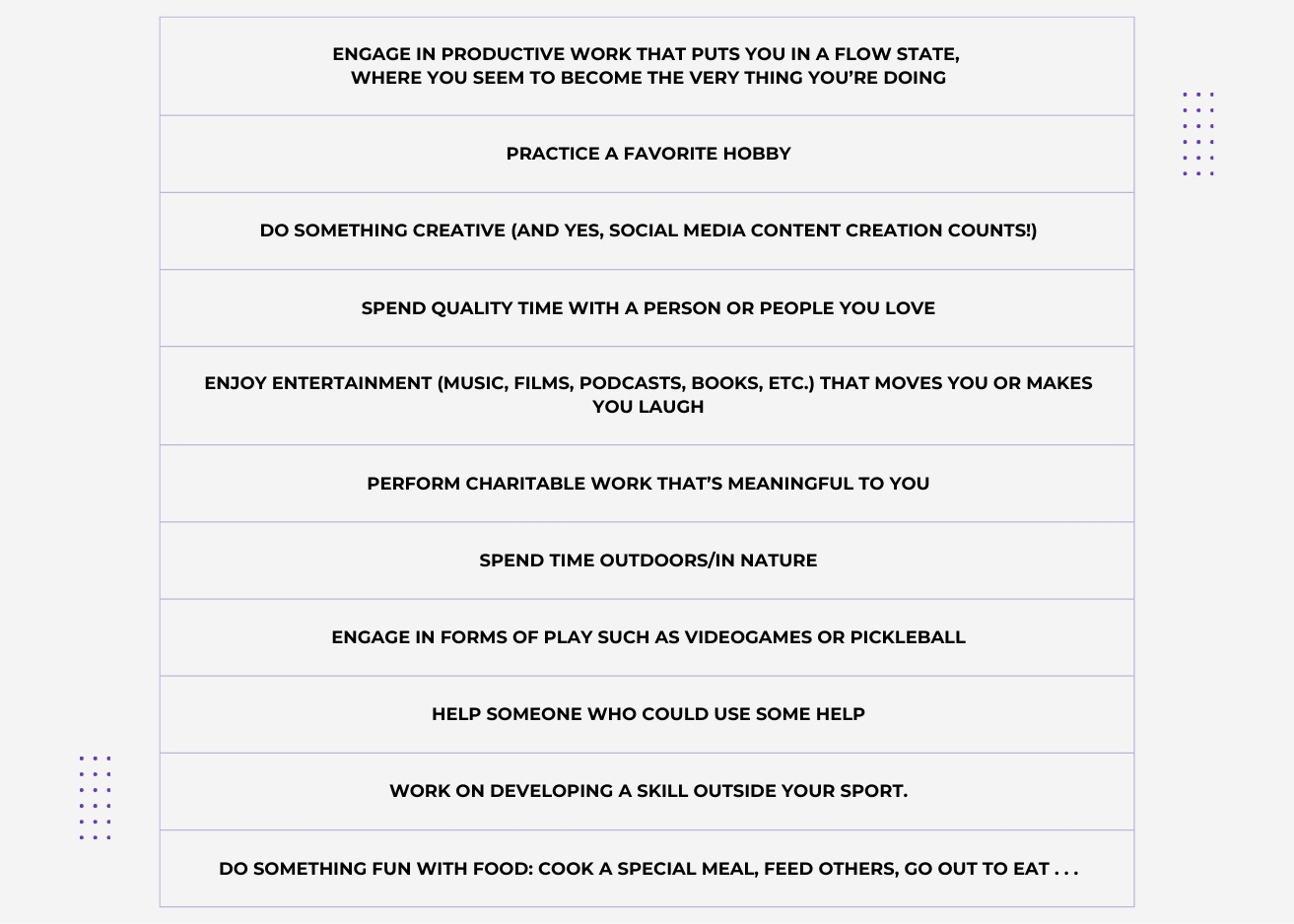
Simply stated, the more positive emotions you experience during the day, and the happy you are as a result of all these positive emotions, the better your recovery will be and the better you will feel and perform in your workouts. Here are some ideas for infusing more positive emotions in the gaps between training sessions in your life:
Engage in productive work that puts you in a flow state, where you seem to become the very thing you’re doing.
💬 What about you - after a tough long run, do you prefer total rest, or do you feel more recovered when you dive into something that makes you happy or keeps your mind engaged?
🤍 Thanks for reading,
Matt Fitzgerald and MarathonGuide Team
Matt, what you describe isn’t overdoing it—it’s a different *form* of recovery.
Most runners treat post–long run time like a battery on the charger: lie down, do nothing, wait. You’re doing something more interesting physiologically: you’re redirecting the arousal of hard exercise into meaningful, chosen mental work. That can actually *lower* perceived fatigue and stabilize the system—exactly what the “undoing effect” suggests.
From my side as a physiologist, I’d say you’re living a nice example of **equilibrium–engagement–optimization**: the run stresses the body, the writing engages the mind, and together they leave you less tired, not more. The key is not inactivity, but coherence between what you do with your body, your brain, and your identity as a runner–creator.
Thought provoking